T20 cricket is a batter’s paradise. We live for the sixes, the 200-plus scores, and strike rates touching the stratosphere. But every so often, the music stops. The boundaries dry up, and the scoreboard remains almost unchanged. Have you ever watched a game where your favorite star can’t seem to find the gap?
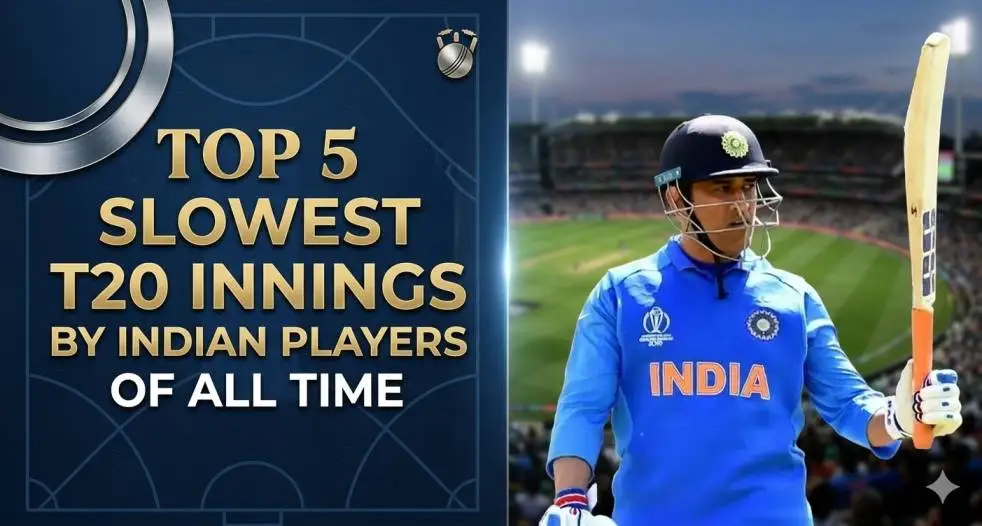
It is frustrating, confusing, and somewhat off. We usually celebrate the fastest knocks, but today, we are looking at the other side of the coin. We are analyzing the top 5 slowest T20 innings by Indian players.
These are the knocks where the batter scored at a crawl. But here is the million-dollar question: Were these innings a sign of failure, or was there a hidden method to the madness?
I've watched many matches and studied player patterns. I noticed that "slow" knocks show more about a player’s character and the game’s pressure. They often say more than a flashy century.
Let’s dive into the list, look at the numbers, and understand the real story behind them.
The Criteria: What Makes an Innings "Slow"?
Before we name names, we need to set the ground rules. When we discuss the top 5 slowest T20 innings by Indian players, we focus on the strike rate.
Read Also: Top 5 Fastest Century in T20 International Cricket History List
This includes innings where a batter faced more than 15 balls but had trouble rotating the strike. We focus on international T20 games. We also watch high-profile domestic games. Context is important.
The List: India’s Most Cautious T20 Knocks
Here is a detailed look at the five innings that tested the patience of fans worldwide. They rank these by the gap between balls faced and runs scored. This shows the high pressure of the format.
1. Not possible to remove the adverb.
Yes, you read that right. The chase master himself features on this list. In the T20 World Cup 2024 match against Ireland, Virat Kohli made 1 run off 5 balls before getting out.
-
The context: The pitch was tricky after the rain. There was lateral movement available for the Irish pacers
-
The Experience Factor: Watching this live, you could see the discomfort. Kohli was poking at deliveries outside off, not getting his customary stride forward. In T20, five balls represent almost an entire powerplay over. Scoring one run off them is a massive blow to the momentum
-
The Verdict: This was a complete failure. A world-class batter struggled to score a run until someone found an edge due to a rare technical misjudgment. It proves that even the greats are human
2. The Captain's Blockathon: MS Dhoni (5 off 12) vs South Africa, 2009
In the 2009 ICC T20 match, India was chasing a modest target of 131. Yet, the top order collapsed. In walked MS Dhoni, the ultimate finisher. But on this day, he managed only 5 runs off 12 balls before getting run out.
-
The Context: India was reeling at 3/56. The asking rate wasn't high, but the need for a partnership was.
-
Honest observation: Dhoni wasn't trying to be slow; he was trying to survive. The South African bowling attack was relentless. Yet, a strike rate of 41.66 is almost unforgivable in T20s. He failed to rotate the strike, and the mounting pressure resulted in his run-out. Defensive batting in a short format can raise the risk of losing wickets. This is a classic example of that.
-
Who is this for? If you coach "situational awareness," this inning shows what not to do. The run rate is low, but wickets are still falling.
3. The Defensive Wall: Yashpal Singh (6 off 20) vs. Indian T20 League, 2009
This is perhaps the most infamous entry in the list of the top 5 slowest T20 innings by Indians. Yashpal Singh, playing for Kolkata, managed only 6 runs off 20 balls. He was chasing a small total of 102.
-
The context: The team needed over 5 runs an over. There was no need for risks
-
Practical Advice for Players: In T20, being too careful can be risky. By refusing to score, Yashpal transferred the pressure to the non-striker. He consumed 20 balls, which corresponds to almost 3.5 overs, for the runs gained from a single boundary. This often leads the batter at the other end to take a rash decision. It’s a textbook example of how a lack of intent can collapse a chase.
-
Safety Tip: When playing on a tough pitch, keep a "survival" mindset. Also, look for ways to rotate the strike. Farm the strike but score
4. The Spinner's Struggle: Ravichandran Ashwin (10 off 20) vs New Zealand, 2016
In the 2016 T20 World Cup, India faced New Zealand on a rank turner in Nagpur. Ravichandran Ashwin, a night-watchman type of promotion, scored 10 off 20 balls.
You Must Also Like: Virat Kohli All Format Centuries List 2026 (ODI, Test, t20)
-
The context: The pitch was a minefield. Spinners were getting the ball to square and bounce.
-
Expertise & Honesty: Ashwin is a genuine all-rounder, but in this instance, he exposed his primary skill (batting defense). He couldn't find the gaps. This innings shows that "batting depth" on paper doesn't always mean runs on a tricky surface. His slow scoring put more pressure on MS Dhoni to score. This led to a skilled chase, but it wasn’t successful.
-
Who is this NOT for? If you're a lower-order batter, "seeing off" a bowler isn't enough. You should aim to target specific bowlers to score.
5. The Uncharacteristic Slog: Yuvraj Singh (11 off 21) vs Sri Lanka, 2014
Yuvraj Singh, the man who once hit six sixes in an over, scored 11 off 21 balls against Sri Lanka in 2014.
-
The context: Yuvraj was returning to form, and the team was banking on his experience in the middle overs.
-
The Observation: It was painful to watch. The timing was off. The big swings resulted in edges or dots. This innings felt like a player battling his own instincts. The "hero" ball wasn't working, and the safe singles weren't coming.
-
Takeaway: Even the most explosive players have off days. This shows why a strong batting lineup is key. If one experienced player struggles, the team can still perform well.
Innings Break Time in T20: The 10-Minute Reset
You might wonder how players bounce back from such slow starts or poor performances. This brings us to a crucial tactical element of the game: the innings break time in T20.
Unlike ODIs, which have a 45-minute interval, the innings break time in T20 is only 10 minutes. This is a very brief statement.
-
Why does this matter? A batter who plays a slow, grinding innings has little time to reset. They must prepare both physically and mentally before returning to the field.
-
A batter who struggles for 20 overs may take that frustration onto the field. They need to use those 10 minutes in a productive manner. It takes great mental strength to move past a personal failure and concentrate on stopping runs.
Learning from the Slowest: Practical Advice for Cricketers
If you’re an aspiring cricketer, these innings are treasures of knowledge. Here is how to avoid finding yourself on such a list:
-
Assess, Don't Obsess: When you come in to bat, assess the pitch and bowling in the first 2-3 balls. If you haven't scored off the first 5 balls, you need a plan. Do not go into a shell.
-
Rotate the Strike: As seen in Yashpal Singh's innings, dot balls kill chases. Work on your singles. Use your feet against the spinners. Steal quick runs. A strike rate of 70 is acceptable if you are scoring 14 off 20, but 6 off 20 is catastrophic.
-
Target the Right Bowler: If one bowler is dominating you, like Ashwin does against spinners, take a smart risk against another bowler. Don't let one player bowl six dot balls to you in a row.
-
The "Dil scoop" and innovation: Modern T20 requires innovation. If the field is up, have a premeditated shot. Staying on the back foot to defend a good length often leads to a low score after facing several balls.
Final Words: The Human Side of T20
T20 is ruthless. These top 5 slowest T20 innings by Indian players remind us that cricket isn’t about surprises. It’s also about the certainty of failure at times.
While we love the 360-degree shots and the 140-meter sixes, these slow knocks add depth to the sport. They remind us that behind the jersey is a person facing form, pressure, and sometimes a great ball.
Next time you see a batter struggling, don't boo. Look at the context. Is the pitch doing something? Is the pressure too high? Understanding the "why" behind slow T20 innings sets a true student apart from a casual fan.
Frequently Asked Questions (FAQ)
Q1: Who has played the slowest T20 innings by an Indian with a strike rate?
Yashpal Singh scored 6 runs off 20 balls in the 2009 Indian T20 League. His strike rate was 30. Many consider this innings to be one of the slowest in Indian cricket history.
Q2: How long is the break between innings in T20?
A: The official innings break time in T20 is only 10 minutes. We aim to complete the entire match within about 3 hours.
Q3: Did Virat Kohli ever play a slow T20 innings?
A: Yes. Virat Kohli has an amazing record, but he has had slow innings. Recently, he scored only 1 run off 5 balls against Ireland in the 2024 T20 World Cup.
Q4: Are slow innings always bad for the team?
A: Not always. Sometimes, a team needs a slow, steady innings when wickets are falling fast. While the knocks above usually hurt the team, this approach can help stabilize the game. In modern T20, a strike rate under 100 is usually seen as a liability. This is true unless the target is very low.